Pelikan Blue (animated film by László Csáki, 2024)

The ELTE–NFI University Film Club continues the series of screenings and discussions. We welcome university citizens from all faculties of ELTE.

Since its premiere, Pelikan Blue has won twelve awards and accolades both at home and abroad. It invites viewers on a truly nostalgic journey, evoking real events with plenty of humor and contemporary music. Today, it is natural for us to travel and cross national borders several times a year, but this was not always the case. In 1988, everyone in Hungary could apply for a passport, the borders were opened, and travel became possible, but train and bus travel was very expensive. What is freedom worth if you cannot enjoy it? Three good friends, Ákos, Laci and Petya, who long to visit Europe, get the phone number of a guy who sells fake train tickets. Thus begins their adventure, during which they discover that the tickets are filled out by hand with indigo ink (Kék Pelikan), and the copy is given to the passenger, while the „original” copy, written with a ballpoint pen, remains with MÁV (Hungarian State Railways). In an apartment in a tenement building in downtown Budapest, chemical experiments with the tickets begin...

Preview: https://www.youtube.com/watch?v=oPUKKYJaM_o&t=57s

Date: 17 September 2025, 18:00

Venue: University Square campus (1053 Budapest, Egyetem tér 1-3. fszt., corridor next to the cloakroom)

"This film, which masterfully combines animation and documentary techniques, revealed Hungary to us not only in a personal context, but also in a broader social and historical context. The experience was dynamic and contemporary. Distinctive and captivating characters guided us through the story, not only enchanting us but also making us their accomplices in the search for freedom. All this, wrapped in a vibrant world of sound and visuals, made the film experience entertaining and unforgettable," read the jury's statement at the Stuttgart festival, which awarded the production the prize for best feature film.

Our guests in the post-screening discussion are director László Csáki and Zsuzsanna Ács, who painted the film, appeared in the scenes and edited the making-of film.

Ács Zsuzsanna
             Zsuzsanna Ács
László Csáki
                     László Csáki


Due to limited seating, please register in advance here:

https://www.ajk.elte.hu/content/kek-pelikan-csaki-laszlo-animacios-filmje-2024.e.1913

Correspondence about the film club is welcome via eltenfi.filmklub@elte.hu.
The ELTE–NFI Filmklub on Facebook 

Source/author of illustration:
National Film Institute

Subscribed Academic Databases at ELTE

Eötvös Loránd University is committed to supporting scientific research and education by providing access to a wide range of subscribed databases for its faculty members and students:

  • University-level access within the framework of the Electronic Information Service (EISZ) National Programme.
  • Faculty-level subscriptions, available locally on the respective faculty’s network.

The up-to-date list of subscribed databases is available on the website of the University Library and Archives.


ELTEFind – the Integrated Search Platform of ELTE

ELTEFind is the literature search service of the University Library and Archives, enabling simultaneous search across the following resources:


Access Options

  • Online resources are automatically available within the university’s IP range.
  • Remote access is possible via the university VPN service.


Further Information and Support

If you have any questions regarding the databases, please feel free to contact us at eisz@lib.elte.hu

Source/author of illustration:
ELTE ULA, The illustration was created using ChatGPT.

The return of our priceless cultural heritage

On July 23, 2025, Foreign Minister Péter Szijjártó announced that the New York District Attorney's Office had returned a priceless publication written in 1675 to Hungary, which had previously been stolen from Budapest.

The publication in question is Nervus Opticus sive Tractatus theoricus by Jesuit monk Zacharias Traber (1611–1679), which appeared at an auction at an antique bookshop in New York in March 2022. A handwritten note on the title page indicates that it once belonged to the library of the Jesuit college in Nagyszombat, the predecessor of the University Library. The volume, published in Vienna in 1675, is divided into three books: optics (the science of light), catoptrics (the science of reflected light, i.e., reflection), and dioptrics (the science of refraction). The title page of this richly illustrated publication was created by copperplate engraver Tobias Sadeler (c. 1641–1679), and it was probably his workshop that produced the plates containing the illustrations. In addition to the fundamentals of optics, Traber also analyzes the practical tasks involved in producing various catoptric combinations based on his personal design experience. The chapters describing the archbishop's garden in Bratislava are an important historical source. The volume was published with two different dedications: one part contained a dedication to Karl von Liechtenstein-Kastelkorn, Bishop of Olomouc (1664-1695), while the other part contained a dedication praising György Szelepcsényi, Archbishop of Esztergom. Only three copies dedicated to Archbishop Szelepcsényi are preserved today in Hungarian public collections.

As the legal successor to the library of the Jesuit college in Nagyszombat, the ELTE University Library and Archives launched an extensive investigation to determine whether the volume that appeared in New York was identical to the copy missing from our collection. With the help of the antiquarian bookshop that announced the auction, it was proven that the elements proving that the volume once belonged to a public collection had clearly been removed: a small stamp was found on the title page, and the flyleaf and endpaper (where other ownership stamps would have been) had been replaced. Multispectral imaging revealed that the volume had once borne the ownership stamp of the former Collegium of Baron József Eötvös. After lengthy research, it was finally possible to reconstruct the volume's adventurous journey. According to the University Library's manuscript catalogues, it still had seven copies of the volume in 1690. In 1777, when the library moved from Nagyszombat to Buda, it only had two copies left. During the move, approximately three thousand volumes that were no longer necessary for university education were left behind in Nagyszombat, and most of these were distributed among various church institutions and individuals. This is how one copy of the volume ended up at the Catholic High School in Pozsony, and from there to the library of the Eötvös József Collegium. It disappeared from the Collegium in the 1940s, and now, some eight decades later, thanks to the cooperation of the ELTE University Library and Archives, it can be returned to its rightful owner.

Details of the lengthy and exciting investigation can be found in Dr. Kulcsár Szabó Ernőné Gombos Annamária's article entitled Everything you wanted to know about the protection of public collections but were afraid to ask.

Source/author of illustration:
https://www.flickr.com/photos/internetarchivebookimages/14570125590/

Reporting Day K21 – Results in the light of quality improvement

At the second quarterly report of the K21 Quality Coordination Committee 2025, the leaders of the working groups reported on the results of the past quarter, ongoing work and changes.

The K21 Quality Coordination Committee unanimously adopted the report on the survey on the use of electronic content. The Library Council approved the Quality Improvement Report of the University Library Service (ULS). The report was forwarded to the ELTE Quality Improvement Committee. The evaluation of the results of the ELTE Staff and the Student Needs and Satisfaction Survey has been begun by the Primer Research Working Group.

The Communication Working Group provided information on the tasks and achievements of the working groups through the website, the newsletter and the short film 3 months – 3 minutes on the mailing list, as well as contributed to the success of the preparation and administration of the K21 reporting days meetings. The group has provided additional news on the ELTE Libraries platform, including online credit card payments, as well as exhibitions and events on the occasion of the International Day of Special Needs Education, which were also published in our newsletter. The Green Library Questionnaire has been sent out and the results are expected to be published in the autumn.

During the quarter, Aleph–SAP data transfer and the SimplePay payment options were launched, simplifying the accounting of library income and the settlement of fees for services. The Library Leaders Working Group held three meetings to discuss, among others, IT challenges affecting library services, the introduction of a new chat channel, the report of the Office of Academic Policy on ELTE's publication performance in 2024, the summer shutdown of the Integrated Library System and the challenges of the ELTE ULA Savaria Library and Archives conversion.

An update on the achievements of the K21 Quality Coordination Committee and our new developments will be posted on our website soon.

Source/author of illustration:
ELTE ULA

System Downtime for Maintenance

We would like to inform our readers that, in line with the summer closure of the ELTE libraries, the ELTE library system will be shut down for maintenance from July 28 to approximately August 24, 2025.
During this period, reader services and the following online functions will not be available:

  • Logging into the ELTEfind catalog (search functionality will remain accessible),
  • Renewing loans and settling fines via the ELTE Library WebApp,
  • Processing online registration requests (these will only be reviewed once the system is back online).

Please note that during the maintenance period, library staff will also not have access to the system, so it will not be possible to renew loans or handle reader-related matters via phone or email.

Source/author of illustration:
AI, EKL

Academics at ELTE – Zoltan Bay

The Hungarian Academy of Sciences will celebrate its 200th anniversary in 2025. Among its members are many distinguished students and teachers who have left their mark not only on the Academy but also on the history of our institution. Zoltan Bay (1900–1992) physicist, university professor was a member of the Hungarian Academy of Sciences from 1945.

Zoltan Bay completed his secondary school studies at the Reformed College of Debrecen, and then at the Faculty of Mathematics and Physics of our University. Under the influence of his role model, Loránd Eötvös, he decided to pursue research in the natural sciences. During his university years, he was a member of the Eötvös Collegium, and later became an assistant professor in the Department of Theoretical Physics at the university. In 1926 he obtained a doctorate in physics with the highest distinction, sub auspiciis gubernatoris. After years at the University of Berlin and the University of Szeged, he habilitated at the University of Budapest in 1936. He continued his research work in the laboratory of the United Incandescent Company and at the Technical University of Budapest. During this period, he was awarded patents for several inventions, such as the development of high-voltage gas pipes and radio receiver circuits. He was the first person in the world to apply the principle of secondary electron multiplication to atomic counting, and today it forms the basis of all the techniques used in fast atomic counting. During the Second World War, he organised a resistance movement and undertook the construction of a secret radio transmitter. In December 1946, he was awarded the Silver Medal of the Order of Freedom, together with Albert Szent-Györgyi, for his wartime activities. In the summer of 1945, he and his research team began the first experiments in Europe to detect radar echoes from the Moon. The distance measurements that could be made with this method have greatly improved our knowledge of distances in the solar system. Forced to emigrate in 1948, he became a professor of experimental physics in the United States of America, working with Albert Szent-Györgyi and János Neumann. From 1955 he worked at the National Bureau of Standards, primarily working for the introduction of a length unit standard based on the speed of light. Measurement played an extremely important role in his work. He has played a decisive role in the development of modern measuring techniques, including the development of extremely accurate time and length measurement procedures. His results have contributed significantly to the development of space technology and the Global Positioning System (GPS). Part of his legacy is preserved in our archives.

Source/author of illustration:
ELTE University Library and Archives

Mosaics from the heritage of ELTE – July 2025

Object of the month – Furniture of Gábor Devecseri

Gábor Devecseri (1917–1971), Hungarian poet, writer, literary translator, classical philologist and poet, winner of the Kossuth and two-time Attila József prizes, and his wife Klára Huszár spent their summers in Szombathely as creative artists of the Iseum Games in the 1960s and early 1970s. They were key figures in the cultural life of the town, initially staging the works of Plautus and later Mozart.

After the death of her husband, Klára Devecseriné Huszár wished to donate her library to a Hungarian higher education institution, where teachers of Hungarian language and literature are trained, and the legacy is processed and maintained while preserving the collection in its original form. This is how the Gábor Devecseri Special Collection was established in March 1982, according to the foundation charter, and housed in the Council Hall of the Berzsenyi Dániel Teacher Training College (now ELTE Savaria University Centre), Building B. In 1992, Katalin Tóthné Király edited the library's volume catalogue, which lists the documents in the storage order of the collection, refers to the marginal notes and contains the full text of the various dedications. In the introduction to the catalogue, Klára Huszár wrote of her husband's library: “it is not a scientific collection, nor the legacy of a book collector, but that of a passionate reader and a writer-translator intoxicated by the “workload”, whose working tools and delightful relatives are these volumes”.

A few years later, Gábor Devecseri's son János Devecseri donated a table and chairs from his father's estate to the Savaria Library and Archives of the Eötvös Loránd University Library and Archives, with the intention of placing it with the poet-translator's library of over 4,000 volumes. The gift furniture had been part of the artist couple's home since the early 1950s, “participating” in the creation of their works and “witnessing” conversations between friends.

According to sources and the family, artists, scientists and public figures met regularly around the table: Zoltán Kodály; István Anhalt; Lajos Bárdos; György Somlyó and Mariann Csernus; Ferenc Karinthy, his wife and son Márton; János Vajna, András Bródy and Márta Vajna; Alfréd Rényi and his wife; Vilmos Zolnay; Imre Trencsényi-Waldapfel and Margit Petrolay; Emil Schultheisz; Aladár Dobrovits and Tekla Dömötör; István Polgár Telegdi and Grácia Kerényi; György János Szilágyi; József Szendrő; Klára Antal Szerb Bálint; István Örkény and Zsuzsa Radnóti; Vilmos Zolnay; Magda Csécsy. In addition to them, at the table: Anna Bede; members of the Benedek family; Iván Boldizsár; Tibor Déry; József Fodor; István Eörsi; Róbert Falus; Oszkár Gellért; Géza Hegedüs; Miklós Hubay; Csilla Kárpáty; István Lakatos; Elek Máthé; Zsigmond Ritoók; István Vas; Béla Vihar.

The table and four chairs are now on display in the community space on the second floor of the Savaria Library and Archives building of the ELTE University Library and Archives.

Written by Eszter Molnár

Source/author of illustration:
ELTE EKL Savaria Library and Archives

Cold Days (black and white Hungarian feature film, 1966)

The Hungarian feature film Cold Days will be screened in the framework of the ELTE Hungarian Summer University in the Carpathian Basin. In addition to the participants of the Summer University, the event is open to all ELTE citizens.

Cold Days focuses the plot on a hitherto silenced historical event, and is a feat of writing, acting and directing that transcends the subject to explore universal questions of responsibility. In 1942, Hungarian army officers ordered a raid in the Bácska region, resulting in the murder of two thousand five hundred Serbs and eight hundred Jews. Three thousand three hundred people disappeared „without a trace” in a hole blown up on the ice of the Danube where the victims were shot. The four participants in the massacre, awaiting their sentences in a common cell, recall the terrible „cold days” of five years ago... The former soldiers recount what happened during those three freezing days. The conversations, approached from different perspectives, reveal terrible secrets.

The Cold Days is an inescapable classic. András Kovács’s work has gone down in film history as one of the greatest feats of Hungarian modernism. Tibor Cseres has brought to the screen a historical fact-finding novel summing up twenty years of research.


Date: 9 July 2025; 18:30

Venue: ELTE University Library and Archives (1053 Budapest, Ferenciek tere 6, Community space from the lobby, ground floor)


Director: András Kovács

Screenwriter: András Kovács, Tibor Cseres

Cinematographer: Ferenc Szécsényi

Main actors: Zoltán Latinovits, Iván Darvas, Tibor Szilágyi, Ádám Szirtes, Margit Bara, Éva Vass

Preview: https://www.youtube.com/watch?v=PZEy0rnW4j4

Our guests in the post-screening discussion are Tamás Stark, historian (HUN-REN Research Centre for Humanities, Institute of History) and Gábor Gelencsér, film historian (ELTE BTK Institute for Art Theory and Media Research, Department of Film Studies).


Stark Tamás
                  Tamás Stark
Gelencsér Gábor
                  Gábor Gelencsér


Source/author of illustration:
National Film Institute

Successful Night of Museums at the ELTE University Library and Archives

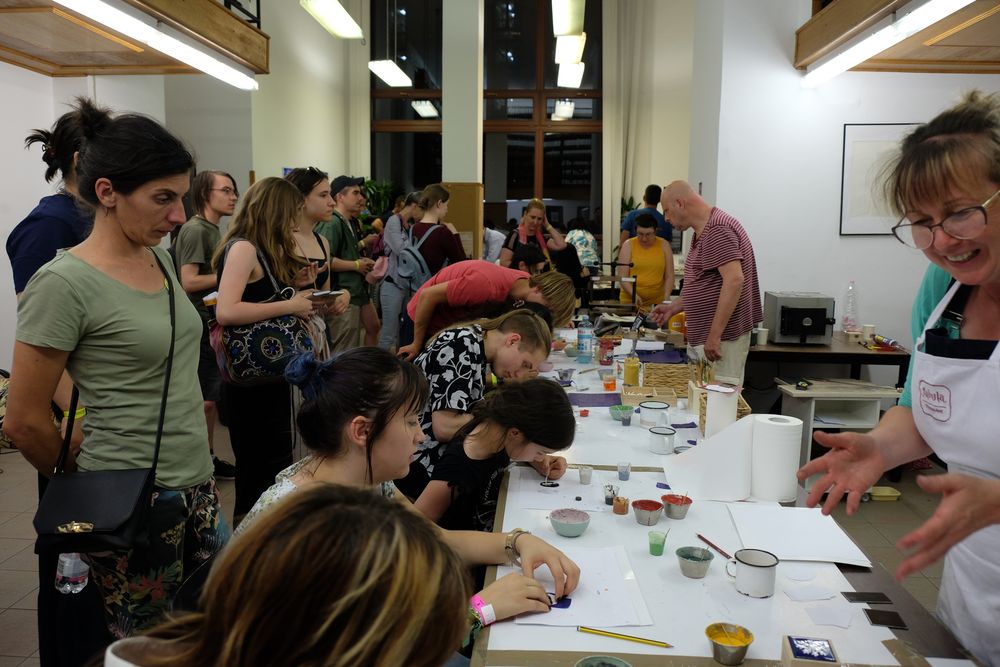
According to our tradition, this year we joined the Night of Museums series of events, which included craft activities, concerts, film screenings, guided tours, restoration, fire enamel and calligraphy workshops, as well as a Mór Jókai Memorial Exhibition. 

The bookbinding and fire enamelling workshop, the calligraphy workshop and the guided tours of the Mór Jókai Memorial Exhibition, with quizzes, puzzles and bookmark colouring, were waiting for the kids and adults from 15.00. The evening programme opened with a concert by the ELTE Béla Bartók Choir and the University Concert Orchestra, conducted by László Kovács, Liszt Ferenc Prize-winning artist, and accompanied by Dr. Ferenc Rákosi on piano.

Through our building tours, visitors were given an insight into the history of the library and the rooms of the historic building. They were also able to learn about the restoration process, our museum collection, the life and work of Mór Jókai, as well as enjoy a film screening of the cartoon Saffi, the Treasure of Swamp Castle and the silent film The Man with the Golden Touch and create unique hardcover books. During our event, our guests were able to attend the Fuvalom Singing Ensemble concert.

Our commemorative exhibition „Jókai 200 – The soul of a century, the writer of a nation”, inaugurated at this year’s event series, will be open until 10 September 2025, on weekdays between 10.00 and 15.00. Registration is possible by e-mail at titkarsag@lib.elte.hu. All visitors are welcome!

Night of Museums


Source/author of illustration:
ELTE ULA

Jókai 200 – The writer of a nation, the soul of a century

Komárom, March Youths, Laborfalvi, The Man with the Golden Touch, Balatonfüred, Svábhegy – so many words calling to the writer-prince. On the occasion of Jókai's 200th birth anniversary, our library joins the Night of Museums with an exhibition that recalls the novelistic world of Jókai, the defining moments of his life and the spirit of his times.