Memories of Rivers (film by Judit Elek, 1989)

The ELTE–NFI University Film Club screening and discussion series continues. We welcome university members from all ELTE faculties.

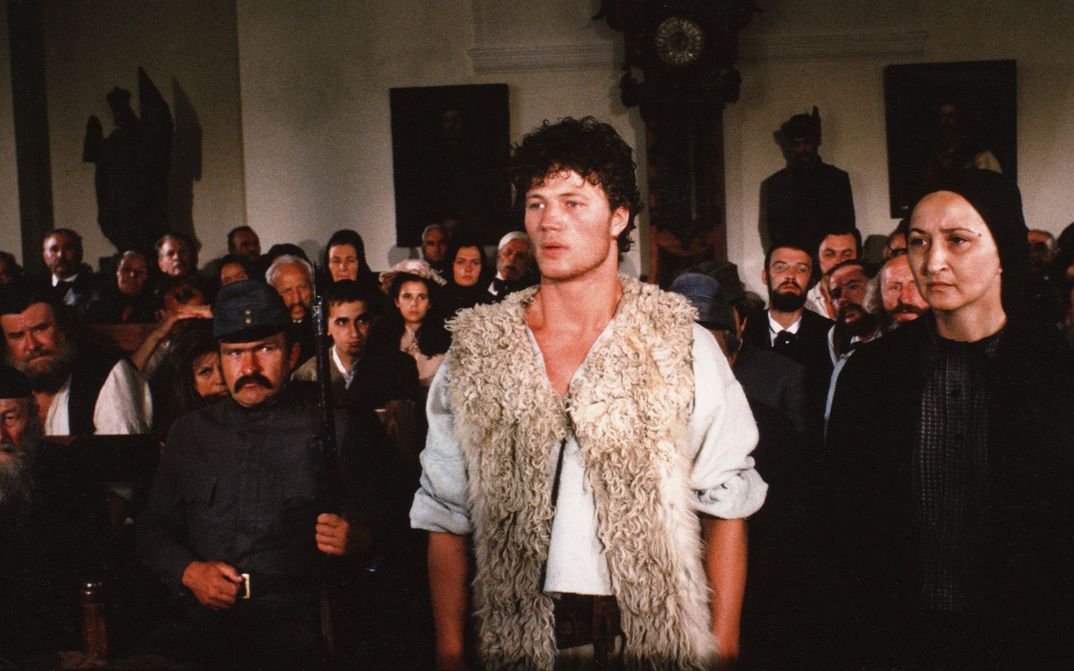
Judit Elek's historical film presents viewers with a possible interpretation of the Tiszaeszlár affair, which began in 1882 and caused a great stir throughout Europe. Before Passover, a maid named Eszter Sólymosi disappeared in Tiszaeszlár, and this incident led to accusations of blood libel. In a small Ruthenian village, where most people earn their living as rafters, the men are preparing for another trip. The women find it difficult to let them go, as if they sense what awaits them. Sailing down the Tisza, they find the body of Eszter Solymosi and become embroiled in the Tiszaeszlár trial. The defendants are represented by Károly Eötvös, the most renowned lawyer of the time.


Date: 3 December 2025; 6 p.m.

Venue: University Square Campus (1053 Budapest, Egyetem tér 1-3, ground floor, A/1 practice room, corridor next to the cloakroom) 


Director, screenwriter: Judit Elek

Cinematographer: Gábor Halász

Editor: Katalin Kabdebó

Music: Péter Eötvös, György Kurtág

Main roles: Sándor Gáspár, András Stohl, Zoltán Mucsi, Róbert Koltai, Tamás Fodor.

Our guests in the post-screening discussion will be: Dr. Mátyás Kapa, university lecturer, lawyer, and writer, who dealt with the trial in his novel Ügyvédsors (The Fate of a Lawyer), published in 2025, and Tamás Fodor, Jászai Mari Award-winning actor, who plays Károly Eötvös in the film.

Dr. Mátyás Kapa
          Dr. Mátyás Kapa
Tamás Fodor
            Tamás Fodor


Due to limited seating, advance registration is required: https://www.ajk.elte.hu/content/tutajosok-elek-judit-filmje-1989.e.1985.

The organizers welcome any correspondence regarding the film club at eltenfi.filmklub@elte.hu.

ELTE–NFI Film Club Facebook page


Tutajosok

Source/author of illustration:
ELTE ULA

Eternal Winter (film by Attila Szász, 2018)

The ELTE–NFI University Film Club screening and discussion series continues. We welcome university members from all ELTE faculties.

Eternal Winter begins in December 1944, when Soviet soldiers take women of working age from a small Swabian village in southern Transdanubia away for „a little work”. They say they are taking them for malenkij robot, meaning they will have to work for three weeks. Irén, who is waiting for her husband to return from the front, says goodbye to her six-year-old daughter and her parents, believing that they will soon be reunited. They are loaded onto a train and, after a long and arduous journey, find themselves in a Soviet labor camp in the Donets Basin, where they are forced to work in inhumane conditions. The Swabians are treated as war criminals and held responsible for the atrocities committed by German soldiers. Here, Irén meets a man named Rajmund, who teaches her how to survive hell. A special relationship develops between the two. Will they ever find their way home? At what price does one survive hell? Can a love born in a labor camp be fulfilled when both of them have families waiting for them at home?

This is the first feature film to authentically portray the story of hundreds of thousands of Hungarians who were taken away for forced labor. Marina Gera won the International Emmy Award for Best Actress for her performance in Eternal Winter.


Date: 19 November 2025, 6 p.m.

Venue: University Square Campus (1053 Budapest, Egyetem tér 1-3, ground floor, A/1 practice room, corridor next to the cloakroom) 


Director: Attila Szász

Screenplay: Norbert Köbli

Cinematographer: András Nagy

Editor: László Hargittai

Music: Gergely Parádi

Cast: Marina Gera, Laura Döbrösi, Franciska Farkas, Sándor Csányi, Diána Magdolna Kiss


Our guests in the post-screening discussion will be Attila Szász, Béla Balázs Award-winning film director, screenwriter, and producer, and Zalán Bognár, historian, president of the International Association of Gulag and Gupvi Researchers, and researcher of the Málenkij robot (forced labour).


Szász Attila
               Attila Szász
Bognár Zalán
               Zalán Bognár  


Preview: https://www.youtube.com/watch?v=HZSTvEVz87I

Due to limited seating, please register in advance at: https://www.ajk.elte.hu/content/orok-tel-szasz-attila-filmje-2018.e.1957.

The organizers welcome any correspondence regarding the film club at eltenfi.filmklub@elte.hu.

ELTE–NFI Film Club Facebook page


Source/author of illustration:
National Film Institute

Mom and Other Loonies in the Family (film by Ibolya Fekete, 2015)

The ELTE–NFI University Film Club screening and discussion series continues. We welcome university members from all ELTE faculties.

An ironic family saga about the turning points of 20th-century Hungarian history and a woman who tried to stay out of history with cheerful irony. Berta, a middle-aged journalist, cares for her 92-year-old mother. The elderly woman, who suffers from dementia, sometimes recognizes her daughter, sometimes not even herself, but she talks constantly. She recounts the family's hundred-year history, how they moved when the current regime put pressure on them: they tried to stay out of history. The film’s style is unique in that it elegantly blends contemporary documentary footage with fictional scenes.

Mom and Other Loonies in the Family is essentially a family saga. The film is a series of short episodes and anecdotes that recount with cheerful irony the trials and tribulations of ordinary people who witnessed history from below. The film lists the dramatic turning points of 20th-century Hungarian history, from Trianon through World War II to the 1956 revolution, but filtered through family memories, they take on a cheerful tone. The family, which bears its fate with unshakeable spirit and humor, moves twenty-seven times to escape the regimes that threaten them.


Date: 12 November 2025, 6 p.m.

Venue: ELTE University Library and Archives, community space (Budapest, V. Ferenciek tere 6.)


Director, screenwriter: Ibolya Fekete

Cinematographer: Francisco Gózon, Nyika Jancsó

Editor: Károly Szalay

Music: János Novák

Main roles: Eszter Ónodi, Danuta Szaflarska, Juli Básti, Tibor Gáspár, Bálint Bán, Kata Bartsch


Our guests in the post-screening discussion will be psychologist and grief counselor Renáta Liliána Révész and the film's director, Ibolya Fekete.


Révész Renáta Liliána
          Renáta Liliana Révész
Fekete Ibolya
                   Ibolya Fekete


Trailer: https://www.youtube.com/watch?v=rta41kov_Qg  

Due to limited seating, advance registration is required: https://www.ajk.elte.hu/content/anyam-es-mas-futobolondok-a-csaladbol-fekete-ibolya-filmje-2015.e.1955

The organizers welcome any correspondence regarding the film club at eltenfi.filmklub@elte.hu.

ELTE–NFI Film Club Facebook page


Source/author of illustration:
National Film Institute

Eviction (film by Máté Bence Fazekas, 2021)

The ELTE–NFI University Film Club screening and discussion series continues. We welcome university members from all ELTE faculties.

The story of an unusual eviction condensed into a single day. Richard, a determined bailiff’s apprentice, has a new task: in his first eviction, he must remove an elderly woman living in a house with a garden on Zrínyi Street. However, Ilona has no intention of leaving her beloved home and puts up a heroic fight, using every means at her disposal to prevent the eviction. What’s more, a couple of activists show up on the scene and form a human chain in an attempt to save the old lady’s life, which is confined to her small house. But Richard is determined and will do everything in his power to achieve his goal. He has the „help” of the police, the fire department, the dog catcher who knows the old lady's pack of dogs well, the zoo workers, and the hostage negotiators. The Eviction was inspired by real events.


Date: 5 November 2025, 6:00 p.m.

Venue: ELTE University Library and Archives, community space (Budapest, V. Ferenciek tere 6.)


Director, screenwriter: Máté Bence Fazekas

Cinematographer: Evelin Judit Tóth

Editor: Marianna Rudas

Music: Dávid Konsiczky

Cast: Ákos Orosz, Mari Nagy, István Znamenák, Blanka Mészáros


Our guests for the post-screening discussion will be Dr. László Béda, enforcement lawyer, and Máté Bence Fazekas, the film’s director.

Dr. Béda László
               Dr. László Béda    
Fazekas Máté Bence
            Máté Bence Fazekas


Trailer: https://www.youtube.com/watch?v=FoY6NiP4Krg

Due to limited seating, advance registration is required: https://www.ajk.elte.hu/content/kilakoltatas-fazekas-mate-bence-filmje-2021.e.1953  

The organizers welcome correspondence regarding the film club at eltenfi.filmklub@elte.hu.

ELTE–NFI Film Club Facebook page


Source/author of illustration:
National Filminstitute

Mosaics from the heritage of ELTE – October 2025

The object of the month – Western long-nosed echidna (Zaglossus bruijnii Peters & Doria, 1876) 

Today, the ELTE Natural History Museum is a repository of the university's natural history and natural science heritage and treasures, covering natural objects, museum education aids, and research tools collected at the university from the late 1700s to the present day. The date of its founding, 1774, is also linked to the founding of the Department of Natural History at that time. The museum has two large exhibition spaces: the Mineral and Rock Collection, with its impressive historical furniture, evokes the 19th century, while the Biological and Paleontological Exhibition is housed in a sunny, 21st-century glass pyramid. The artifact of the month is a western long-nosed anteater from the latter collection.  

Echidnas belong to the egg-laying mammals (Monotremata). Fossils that can be considered their direct ancestors are approximately 17 million years old, but based on modern CT morphometric studies, the age of the humerus bone from the oldest common ancestor of egg-laying mammals is dated to 100 million years ago, and it is considered to be a semi-aquatic (water-bound) mammal with a duck-billed body. Thus, the terrestrial, burrowing lifestyle of today's echidnas is a secondary adaptation. They have retained their good swimming ability to this day. Their anatomical and physiological characteristics combine ancient and modern features: they have a cloaca, reproduce with parchment-like eggs, but feed their tiny offspring with secretions from their mammary glands; their shoulder girdle structure is reptilian; their skeleton is robust; their skull is disproportionate and simple, their jawbone and mandible are elongated like a bird's beak and toothless: deceptively, this unique structure is called both a trunk and a beak. Electro- and mechanoreceptors in the skin covering the trunk help them find their prey. To date, little is known about their lifestyle, distribution, and population size. Based on fossil finds, analysis of indigenous rock paintings, and recent observations, it is certain that they were significantly more common and occurred over a larger area in Papua New Guinea, Australia, and Tasmania, in both dry and wet tropical environments. Their scientific name is thought to derive from Echidna, a half-human, half-snake creature from Greek mythology. There are four known extant species of echidnas. 

Our collection includes a male specimen of the western long-beaked echidna (Zaglossus bruijnii). It is of outstanding scientific and historical value.   

This species is the largest and has the thickest fur among its relatives, with a slightly downward-curving "beak-like trunk." The lifelike specimen was prepared by the famous German taxidermist Gustav Adolph Frank, and its acquisition is documented as having taken place in 1886–87. The species lives in the higher tropical mountain forests of Papua New Guinea, is sluggish, and is mainly active at night. During the day, it rests in bushes, among roots and rocks, or in burrows dug and abandoned by other animals. Like its relatives, it feeds on soil-dwelling invertebrates, which it digs out with its strong claws and nose and easily catches with its long, sticky, spiny tongue (e.g., ants, termites, earthworms). It is solitary, but during the mating season, which lasts for weeks, many individuals chase each other conspicuously, and the female enjoys the company of her offspring for 7-12 months, caring for them. The species is critically endangered (CR) according to the IUCN due to habitat loss, illegal hunting, and introduced predators. 

Written by Dr. Mária Tóth Ronkayné (biologist-museologist, ELTE Natural History Museum Biological and Paleontological Exhibition) 

Source/author of illustration:
ELTE Natural History Museum

Reporting Day K21 – Results in the light of quality improvement

At the third quarterly report of the K21 Quality Coordination Committee 2025, the leaders of the working groups reported on the results of the past quarter, ongoing work and changes.

The Primer Research Working Group evaluated the results of the ELTE staff and student needs and satisfaction survey regarding libraries. The Process Management Working Group coordinates the description of key processes contained in the Quality Management Handbook.

The Communication Working Group provided information on the tasks and achievements of the working groups through the website, the newsletter and the short film 3 months – 3 minutes on the mailing list, as well as contributed to the success of the preparation and administration of the K21 reporting days meetings. The group also provided assistance in publishing further EKSZ news on the ELTE Libraries website, including EKSZ honorees, a welcome message and service description for first-year students, as well as a timeline posted on the occasion of the anniversary of special education teacher training, which also appeared in the EKSZ newsletter.

The data and results of the Green Library questionnaire are currently being summarised.

The Library Managers Working Group held a meeting to discuss changes following the expiry of public procurement contracts for books and periodicals this year, the announcement and conditions of new public tenders, as well as  EISZ procurements for 2026 and current issues.

An update on the achievements of the K21 Quality Coordination Committee and our new developments will be posted on our website soon.

Source/author of illustration:
ELTE ULA