Clarivate warmly welcomes all interested participants to its webinar, featuring practical examples of discovery techniques and their application in the broader systematic literature review process. The presentation will also cover how EndNote supports reference and literature management.
Title: Practical Guidance on Using the Web of Science and EndNote for collecting literature for Systematic Literature Reviews
Date & Time: November 17 (Tuesday), 2.00–3.00 PM CET
Language : English
A systematic review is a complex and comprehensive process that typically involves gathering critical evidence to address a research question. The Web of Science offers a range of discovery techniques that go beyond traditional searching. These include Boolean searching, leading subject classifications and citation analysis. In addition, the Web of Science enables information retrieval across multiple databases within a single search environment, supporting more comprehensive literature searches.
Key topics:
Boolean searching for reproduceable results
Source level and article level classification techniques for broader searching
Uncovering hidden literature using citation analysis
Searching across multiple databases
Managing literature projects with EndNote
Examples of how AI can provide efficiencies in the discovery and identification of critical content
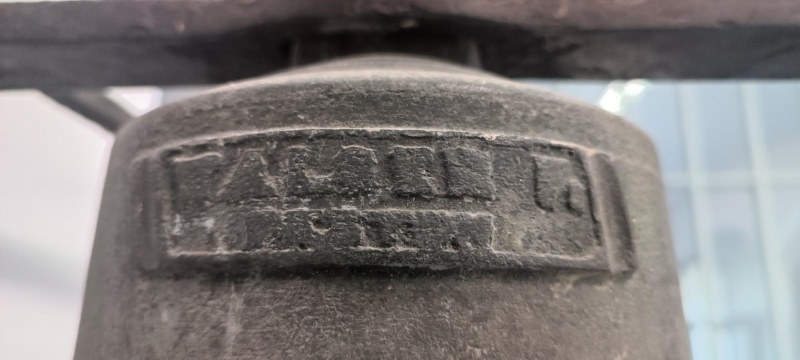
Artwork of the month – A bronze bell calling students to study
The 19th-century bronze bell, presented as this month’s artefact and serving as a reminder of the importance of learning, was once housed in the building of the State Institute for the Training of Primary School Teachers and Nursery School Teachers in District II. Organised in 1869 by Janka Zirzen (1824–1904), the Institute began operating in 1874 at 43 Csalogány Street (formerly Ötpacsirta Street) in District II. Between 1951 and 1956, the Institute and College of Special Education moved into the building, which had been severely damaged during the Second World War, followed by a primary school. In 2010, the building was demolished; according to available information, it was at this time that the bell was moved to its current location.
According to the inscription on the bell, the artefact is the work of Ferenc Walser the Elder (1827–1901). Coming from a family of craftsmen, Walser initially worked as an apprentice to the bell-founder András Schaudt, and it was during his time with him that he developed a passion for the trade. In 1847, he travelled abroad, where he worked in the most prestigious workshops in numerous cities: Linz, Passau, Lauingen, Augsburg, Bamberg and Leipzig. In addition to the craft of bell-founding, he also learnt the manufacture of fire-fighting equipment. In 1858, he opened his own workshop in Pest, which eventually grew into a manufacturing plant where more than 2,000 bells and 7,000 fire-fighting machines were produced. Later, the factory’s reputation spread beyond the borders of Hungary. His work was recognised with several honours during his lifetime, including the Gold Cross of Merit and the Order of Franz Joseph.
The bronze bell is thought to have been cast between 1869 and 1872, as the place of casting was ‘Pest’, meaning it was made before the unification of Pest, Buda and Óbuda in 1873.
The bell forms part of the Faculty of Teacher and Nursery Teacher Training’s Exhibition on the History of the Institution, and is therefore a permanent feature of the interactive tours showcasing the building and its history.
This cast bell, which is over 150 years old, is no longer used for its original purpose, but it does serve a practical function: in accordance with fire safety regulations, the building must still be equipped with a nonelectric alarm that can be used to raise the alarm in the event of a fire.
You can hear the sound of the bell in the recording below:
Text: Anett Abt, Dávid Kontra
Photo: Dávid Kontra
Sources:
A nagyharang (TÓK idegenvezetés egyik QR-kódos állomása, a harang hangjának forrása)
On the occasion of the 400th anniversary of Jesuit monk György Káldi’s Bible translation, the ELTE University Library and Archives and the Department of Early Modern History at ELTE’s Faculty of Humanities are organising a commemorative conference on 20 November 2026, in the ground-floor community circle room of the library building at 6 Ferenciek Square.
Date: 20 November 2026 (Friday), 3:00–5:00 p.m. Location: 1053 Budapest, Ferenciek tere 6, Ground Floor Round Room (community space)
Program
During the conference, the original manuscript of the Káldi Bible translation will be on display.
3:00–3:10 p.m. Opening Remarks: Dr. Kulcsár Szabó Ernőné Gombos Annamária, Director General
Chair: Dr. Krisztina Tóth (ELTE University Library and Archives)
3:10–3:30 p.m. Dr. István Fazekas (ELTE Faculty of Humanities, Department of Early Modern History): The Career of Bible Translator György Káldi
3:30–3:50 p.m. Dr. Antal Molnár (ELTE Faculty of Humanities, Institute of History – ELTE Faculty of Arts, Department of Early Modern History): György Káldi’s Bible Translation Before the Inquisition
3:50–4:10 p.m. Dr. Vera Szádoczki (HUN-REN-PPKE Research Group on Baroque Literature and Spirituality, Vác Diocesan Library): Fragments of the Káldi Bible in Vác
4:10–4:30 p.m. Ágnes Novotny (ELTE University Library and Archives): Beyond the Words – Technical Analysis and Condition Assessment of the Káldi Bible Manuscript
4:30–5:00 p.m. Questions and Comments
All visitors are welcome!
Source/author of illustration:
Department of Early Modern History at ELTE’s Faculty of Humanities
As part of Open Access Week 2026, CHARM-EU organized a two-day online event for researchers and university library staff, showcasing opportunities and best practices in Open Access publishing through the experiences of its partner institutions. During the professional event, two staff members of the ELTE University Library and Archives delivered presentations, highlighting how the institution supports the implementation of Open Science principles.
In his presentation entitled Supporting Open Science at ELTE University Library, Tibor Móring introduced the activities supporting Open Science at the ELTE University Library and Archives, with particular emphasis on the services provided by the Department of Education and Research Support. He paid special attention to institutional support for Open Access publishing, presenting the library services and infrastructures associated with the Green, Diamond, and Gold Open Access models.
Liza Németh's presentation, Transformative Agreements at ELTE, focused on ELTE’s Read & Publish agreements supporting Open Access publishing and the related library services. She provided a detailed overview of how transformative agreements operate, the conditions for using publication quotas, and the research support role of the library and the Open Access Administrator in the Open Access publishing process.
The presentation slides are available on the website below, where a recording of the full programme will also be published at a later date:
Our colleague presented international best practices in data repository management at the HUN-REN ARP Conference.
The annual conference of the HUN-REN Data Repository Platform (ARP) was held on 8 October 2026 at the Research Centre for the Humanities. The event focused on data repositories, the long-term preservation and sustainable management of research data, with special attention to current challenges, emerging trends, and technological innovations in the field.
At the conference, Eszter Pálvölgyi-Polyák, staff member of the ELTE University Library and Archives, delivered a presentation introducing the operations and experiences of a leading American institution that ranks among the world's foremost data repositories. Entitled (Meta)Data for the Future: Insights into the Metadata Management Best Practices of the Inter-university Consortium for Political and Social Research (ICPSR),the presentation focused on best practices in metadata management for data repositories, as well as developments supporting the implementation of the FAIR principles and the reuse of research data, while also offering valuable international perspectives for the Hungarian data repository community.
HyRead is a digital reading platform developed by Lingwang Knowledge Co., Ltd., offering Chinese-language e-books, magazines, and full-text journal content. Its collection includes more than 220,000 e-books, ranging from bestsellers and novels to comics, available to read online. The platform’s cloud-based bookshelf and e-book reading services facilitate access to and use of its digital content.
On the occasion of the 70th anniversary of the events of the 1956 Revolution and War of Independence, the ELTE University Library’s 1956 newspaper collection – which includes Egyetemi Ifjúság (University Youth), the newspaper of Eötvös Loránd University – was once again placed in the hands of its former editor, György Gömöri, a poet and literary historian.
Our library’s collection includes a unique collection of periodicals published during the 1956 Revolution. Following the revolution, library staff set aside not only the revolutionary issues of each newspaper but also some of the subsequent numbers, as well as every newspaper published at that time. The collection was not accessible to researchers until the change of regime; the newspapers were stored in unlabeled boxes deep in the storage area. For a long time, aside from the librarians, only one or two “friendly” researchers knew about the boxes containing the revolutionary newspapers.
Thanks to this isolation, the documents have been preserved in excellent condition. The collection houses numerous rare and unique publications, including ELTE’s weekly newspaper, Egyetemi Ifjúság (University Youth), which is of exceptional historical value from the perspective of the university’s history. This material, which for a long time was known only to a few, has been fully digitized since 2017 and is freely available for research.
The newspaper was originally published under the title Tudományegyetem (University); its name was changed to Egyetemi Ifjúság (University Youth) in 1955, and from 1959 onward it continued under the name Egyetemi Lapok (University News). On 25 October 1956, the editorial board – composed of students – decided to put the newspaper at the service of the revolution. The first issue hit the streets on 28 October, and within a few days it became one of the revolution’s most popular newspapers. Serving as the voice of the University Revolutionary Student Committee, the publication played a significant role as an underground newspaper during those events.
The head of the editorial board, György Gömöri – a former student of Hungarian and Polish at ELTE’s Faculty of Humanities – spoke with Csaba Borsodi, former dean of ELTE’s Faculty of Humanities and a researcher of that era, about his role in the events of 1956. The interview is available on ELTE’s YouTube channel.
Led by the Library Council President, the University Library Service’s Quality Manager and the K21 Quality Management Coordination Committee President, the second quality management awareness-raising training session for ELTE librarians was successfully held on 29 October 2026, with nearly 30 participants.
The primary goal of the training was to reinforce the quality management mindset, increase quality awareness, and promote the integration of quality-centered operations into daily work. In addition to the lectures, practice-oriented workshops provided opportunities for interactive knowledge exchange, collaborative thinking, sharing experiences, and presenting best practices. Based on participant feedback, employees rated the training as extremely useful and effective. They emphasised that the training significantly contributed to strengthening a quality-oriented mindset and to a deeper understanding of work processes and their relationship to quality management.
The ELTE–NFI University Film Club screening and discussion series continues. We welcome university members from all ELTE faculties.
Set against the backdrop of the underground music scene, the film features an absurd love triangle. János Xantus’s film is one of the seminal works of the movement known as ‘new sensibility’ and remains its most popular film to this day. Laci, a well-known pianist, falls in love with the beautiful Mari and, throwing caution to the wind, helps her pursue a career as a singer. However, the mysterious woman is the wife of a deaf-mute zookeeper. Soon her husband turns up, and the impending tragedy is inevitable. The film follows the conventions of romantic melodramas, yet constantly turns the genre on its head and subverts it. Eskimo Woman Feels Coldleaves a powerful mark; it is a film of personal impressions and longing. Stylish and bizarre, it was a defining cinematic experience for a generation. The film was screened at several prestigious international festivals, whilst in Hungary nearly a quarter of a million people bought tickets to see it. Music plays a central role, featuring compositions by the Trabant Band, Gábor Lukin, Mihály Víg and János Másik.
Time: 25 November 2026, 6.00 pm
Venue: ELTE University Library and Archives, community space (1053 Budapest, Ferenciek tere 6, ground floor)
Director, screenwriter: János Xantus
Director of photography: András Matkócsik
Editor: Katalin Kabdebo
Music: Gábor Lukin, Mihály Víg, János Másik
Main cast: Linda Boguslaw, Andor Lukáts, Marietta Méhes
Our guest for the post-screening discussion: Béla Szilárd Jávorszky, music journalist and editor.
Britannica Academic is available to ELTE-citizens for a trial period from the end of October until 20 December 2026.
Britannica Academic is a comprehensive online reference resource offering reliable, expert-reviewed content across a wide range of academic disciplines. The platform provides access to encyclopaedia articles, biographies, primary sources, images, videos, and other multimedia resources to support learning, teaching, and research.
In addition to its regularly updated content, Britannica Academic offers advanced search options, citation tools, translation features, and other research aids to help users find and explore information efficiently.
The platform is accessible to ELTE students and staff through the university's IP network. For remote access, an ELTE VPN connection is required.